




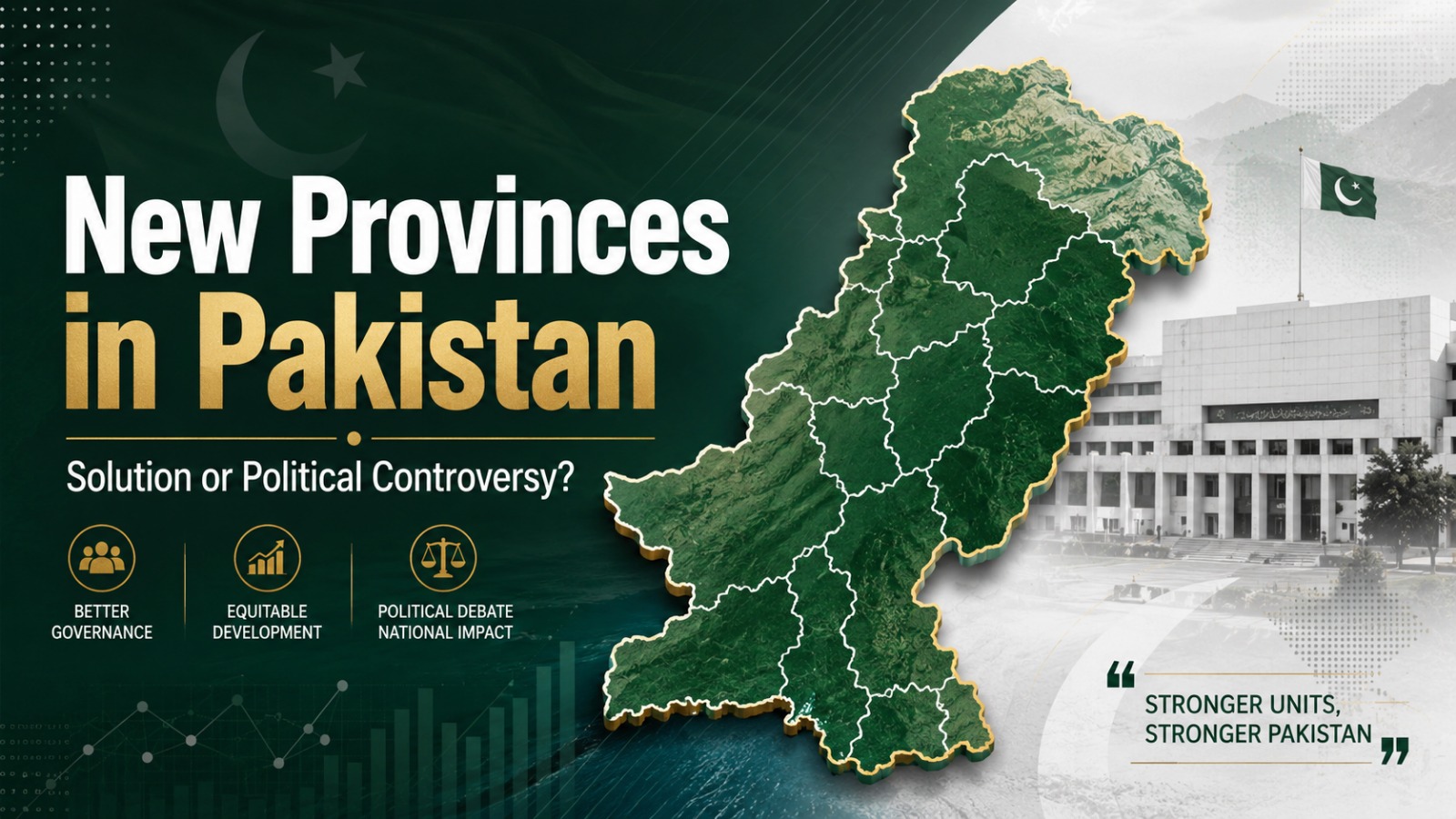
Interior Minister Mohsin Naqvi’s recent proposal has revived the long-standing debate over creating new provinces in Pakistan. The key question is whether smaller administrative units would improve public services or push the country into a new political and linguistic conflict.
Why Has the Debate Over New Provinces Returned?
The creation of new provinces or smaller administrative units has once again become an important issue in Pakistan’s political landscape.
Speaking at the Pakistan Economic Summit in Islamabad on July 30, 2026, Federal Interior Minister Mohsin Naqvi described the existing administrative structure as ineffective. He called for a national consensus on creating new provinces or administrative units to reduce the distance between the government and the public.
However, it remains unclear whether this proposal represents an official federal government policy or Mohsin Naqvi’s personal political opinion.
According to Naqvi, ordinary citizens often have to travel long distances to access courts, government departments and basic public services. He argued that transferring administrative authority closer to the people could improve service delivery, strengthen accountability and help produce more effective local leadership.
Can New Provinces Really Solve Public Problems?
Supporters of new provinces argue that governing provinces with extremely large populations and vast geographical areas from a single provincial capital has become increasingly difficult.
People living in remote areas frequently complain that major cities receive greater attention in development projects, employment opportunities, education, healthcare and infrastructure.
Smaller administrative units could allow decisions to be made closer to local communities. Provincial capitals would become more accessible, local problems could be understood more effectively and government officials could be held accountable more easily.
However, increasing the number of provinces alone cannot guarantee good governance.
If weak institutions, political interference, corruption and ineffective local governments remain unchanged, newly created provinces may face the same problems as the existing ones.
The real issue is not simply the division of territory. It is the fair distribution of authority, resources and accountability.
How Difficult Is the Constitutional Process?
A new province cannot be created in Pakistan through a government announcement or presidential order alone.
Under Article 239 of the Constitution of Pakistan, a constitutional amendment must be approved by at least a two-thirds majority of the total membership of both the National Assembly and the Senate.
If the amendment changes the boundaries of an existing province, it must also receive a two-thirds majority in the assembly of the affected province.
The Pakistan Peoples Party has also stated that new provinces must be created through Parliament and the constitutional process rather than through an administrative order.
The party has announced that its Central Executive Committee will consider the issue. This indicates that the proposal has already pushed political parties to develop formal positions.
## A Major Test for Political Parties
The proposal has emerged at a time when relations between the government and the opposition are already tense.
Pakistan Tehreek-e-Insaf has announced plans to begin a nationwide political campaign from August 5, which may include public gatherings, demonstrations and other political activities.
In such an environment, building political agreement on a sensitive issue like new provinces will not be easy.
Every political party is likely to examine the proposal according to its electoral interests, regional support and future political influence.
Creating new provinces could affect representation in the National Assembly, provincial assemblies and the Senate. It could also influence government employment quotas, financial resources, water distribution and the National Finance Commission formula.
For this reason, the issue is not merely administrative. It also has major constitutional, economic and political implications.
## Possible Risks
If new provinces are created to gain political advantage, redraw electoral boundaries or strengthen particular political parties, the process could damage national unity.
Dividing provinces primarily on linguistic, ethnic or regional grounds could also create tensions between different communities.
Each new province would require its own assembly, cabinet, governor’s house, secretariat, police administration and other institutions. This would significantly increase government expenditure.
Supporters of new provinces must therefore explain how the administrative benefits would outweigh the additional financial burden.
## What Should the Government Do?
The government should first establish an independent and impartial national commission.
The commission should include constitutional experts, economists, representatives of all major political parties, provincial governments and the regions that may be affected.
It should establish clear criteria based on population, geographical area, access to government centres, economic resources, cultural identity and administrative capacity.
The expected costs and benefits of every proposed province or administrative unit should also be presented publicly.
At the same time, Pakistan needs a strong and empowered local government system.
Many governance problems can be addressed without creating new provinces by transferring authority to districts, tehsils and union councils.
Local governments should therefore be strengthened first. After that, policymakers can determine which areas genuinely require the status of a separate province.
## Conclusion
The creation of new provinces in Pakistan is neither a completely unreasonable proposal nor an immediate solution to every administrative problem.
With proper planning, public consultation and constitutional consensus, smaller administrative units could improve governance and bring public services closer to citizens.
However, if the issue is used as a political slogan, an electoral strategy or a source of linguistic division, it could create new disputes instead of delivering meaningful reform.
Pakistan needs a new administrative vision before it needs a new political map.
The country requires a system in which the government is closer to the people, institutions are accountable and resources are distributed transparently.
Real success will not be measured by the number of provinces. It will be measured by whether every citizen receives equal access to public services, political representation and the state’s resources.