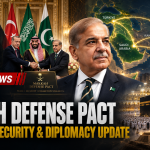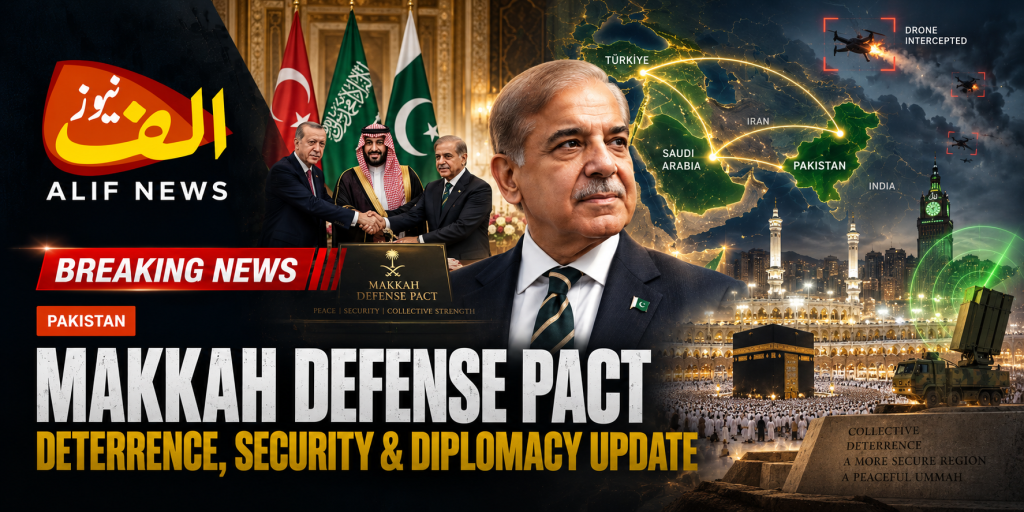





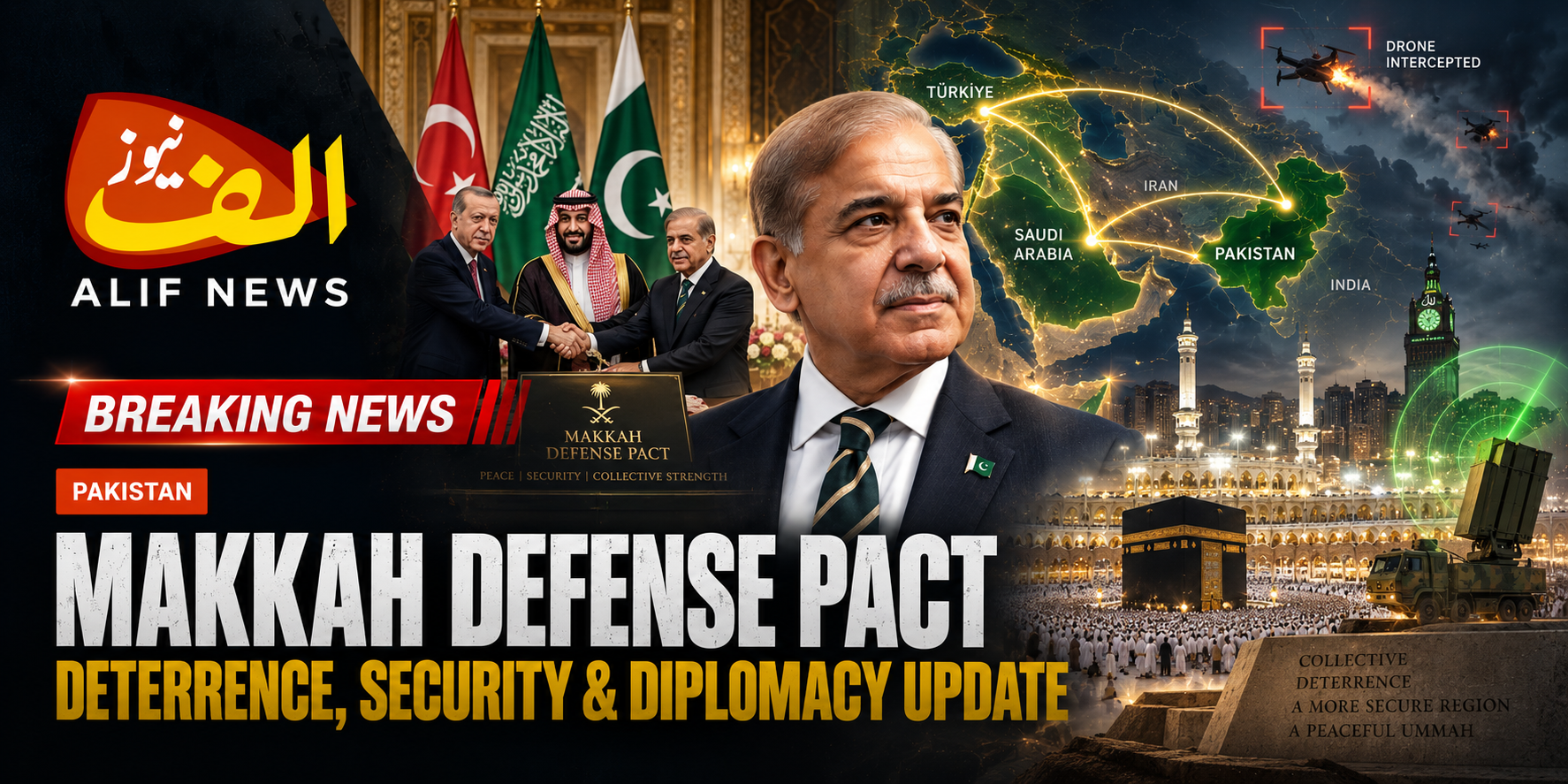
Makkah Defense Pact, Pakistan has moved to clarify the purpose of the newly formed Makkah defense arrangement amid rising tensions in the Middle East, stressing that the agreement is designed for collective security rather than military expansion.
Director General Inter-Services Public Relations (DG ISPR) Lieutenant General Ahmed Sharif Chaudhry said the Makkah defense pact involving Pakistan, Saudi Arabia and Türkiye has “no regional aspirations” and is intended to strengthen collective deterrence. His comments came as Saudi authorities reported intercepting a drone south of Makkah, an incident they attributed to Yemen’s Houthi movement. The Houthis, however, denied that they were targeting Makkah or other religious sites.
Prime Minister Shehbaz Sharif also strongly condemned the reported attempted attack and expressed Pakistan’s solidarity with Saudi Arabia, while calling on all sides to avoid further escalation.
The developments have once again placed the Makkah defense agreement in the spotlight and raised questions about what the pact means, how it could work during a crisis and whether it changes Pakistan’s broader regional security policy.
DG ISPR Says Pact Is Defensive in Nature
Speaking in an interview with Al Arabiya English, Lt Gen Ahmed Sharif Chaudhry described the agreement as a formal extension of Pakistan’s longstanding defense relationships with Saudi Arabia and Türkiye.
According to the military spokesperson, the arrangement is built around collective defense and deterrence rather than offensive military objectives.
“It is defensive,” he said, adding that there was “nothing aggressive” about the agreement and that it carried no regional ambitions. He also described the pact as complementary to the existing international relationships maintained independently by Pakistan, Saudi Arabia and Türkiye.
That clarification is significant because any new security alliance in the Middle East can quickly become the subject of speculation, particularly when regional tensions are already high.
Pakistan’s public position is that the agreement is not meant to compete with other alliances or to create a new confrontational bloc. Instead, Islamabad presents it as a framework through which the participating states can strengthen their ability to discourage aggression.
The distinction between deterrence and aggression is central to the government’s messaging.
In simple terms, deterrence is meant to convince potential attackers that the cost of aggression would outweigh any possible benefit. The idea is to prevent conflict rather than initiate it.
What Does the Makkah Defense Pact Actually Mean?
The agreement between Pakistan, Saudi Arabia and Türkiye was signed in August 2026. Publicly reported details indicate that the pact contains a collective-defense principle under which an attack on one participating state would be treated as an attack on the others.
That wording naturally raises questions about what Pakistan or Türkiye would be required to do if Saudi Arabia came under attack.
DG ISPR avoided discussing operational details, noting that countries do not normally make the practical workings of sensitive defense arrangements public. He said decisions on how the countries would respond to aggression would be a matter for the three governments involved.
This is an important point because collective defense does not necessarily mean that every security incident automatically leads to a large-scale military response.
Pakistan’s Foreign Office recently said no military response had been discussed under the Makkah pact in relation to earlier Houthi attacks on Saudi Arabia.
For now, the agreement appears to provide a political and strategic framework for cooperation, while leaving the exact nature of any future response dependent on circumstances and consultation between the member states.
Drone Intercept Near Makkah Raises Alarm
The latest concern emerged after Saudi Arabia said its air defenses intercepted and destroyed a drone south of Makkah before it entered restricted airspace around the holy city.
Saudi-led coalition spokesman Turki al-Malki said the drone had been launched by Houthi forces in Yemen and described the security of Makkah as a “red line.”
The Houthis disputed the allegation that they were attempting to target Makkah, denying that Islamic holy sites were their intended objective. That competing account means the specific intended target remains disputed publicly.
Whatever the intended destination of the drone, its interception near one of Islam’s holiest locations immediately attracted regional attention.
Makkah holds unique religious importance for Muslims around the world. It is home to the Grand Mosque and the Kaaba and serves as the destination for millions of pilgrims performing Hajj and Umrah.
Any security threat in its vicinity therefore carries significance far beyond Saudi Arabia’s borders.
Shehbaz Sharif Strongly Condemns Incident
Prime Minister Shehbaz Sharif condemned the reported attempted drone attack in strong terms and praised Saudi forces for intercepting the aircraft.
He said the people of Pakistan were deeply disturbed by the incident and reaffirmed Pakistan’s support for Saudi Arabia.
At the same time, the prime minister also called for restraint.
Shehbaz urged the parties involved in the wider regional conflict to step away from further escalation and said dialogue and diplomacy remained the sustainable route toward peace.
That part of his statement is particularly relevant to understanding Pakistan’s wider position.
Islamabad is expressing firm political support for Saudi security while also trying to avoid framing the situation as an automatic step toward a broader war.
The two messages may appear different, but together they reflect Pakistan’s stated approach: support the security of its partner while continuing to advocate de-escalation.
Why the Timing Matters
The Makkah defense pact is still relatively new, which means every major regional security incident is likely to be viewed through the lens of the agreement.
The latest drone episode comes during a period of renewed instability involving Yemen, the Red Sea and Saudi territory. Pakistan’s representative at the United Nations has warned that recent Houthi attacks on Saudi Arabia and developments around the Bab al-Mandab Strait have created a dangerous situation for regional peace and global economic security.
This wider environment makes the language used by Pakistan’s military and political leadership especially important.
By repeatedly describing the Makkah pact as defensive, Pakistani officials appear to be trying to prevent the agreement from being interpreted as a vehicle for regional power projection.
That does not make the pact insignificant. On the contrary, an agreement built on collective deterrence could become an important part of the security calculations of all three countries.
But the way it is implemented will matter just as much as the wording used when it was signed.
No Public Move to Activate Pact Militarily
Despite the seriousness of the latest incident, there has been no public announcement that Pakistan, Saudi Arabia and Türkiye have activated the Makkah agreement for a military response.
Associated Press reported that neither Pakistan nor Türkiye had received a Saudi request to activate the new defense arrangement following the drone incident.
That is consistent with Pakistan’s earlier statements that the agreement should not be read as an automatic trigger for military intervention every time one of its members faces a security threat.
For the moment, the emphasis remains on deterrence, consultation and solidarity.
A Careful Balance for Pakistan
Pakistan’s position on the Makkah pact reflects the difficult balance it often has to maintain in Middle Eastern affairs.
Saudi Arabia is a longstanding strategic partner, while Pakistan also maintains diplomatic and economic relationships across the wider region.
A security agreement that appears openly directed against another country could complicate those relationships.
DG ISPR’s insistence that the pact has no regional aspirations therefore sends a message beyond the three countries involved. The official Pakistani argument is that stronger defense cooperation does not have to mean a more confrontational regional posture.
Whether the agreement succeeds in serving primarily as a deterrent will depend on future events.
For now, Pakistan’s stated position is clear: the Makkah defense pact is intended to discourage aggression, not encourage it.
The drone interception near Makkah has provided an early test of that message. Pakistan has strongly condemned the reported threat, reaffirmed its support for Saudi Arabia and simultaneously called for restraint and diplomacy.
As regional tensions continue, attention will remain focused on how Pakistan, Saudi Arabia and Türkiye translate the language of collective defense into policy — and whether deterrence can help prevent the kind of wider conflict all three governments say they want to avoid.