

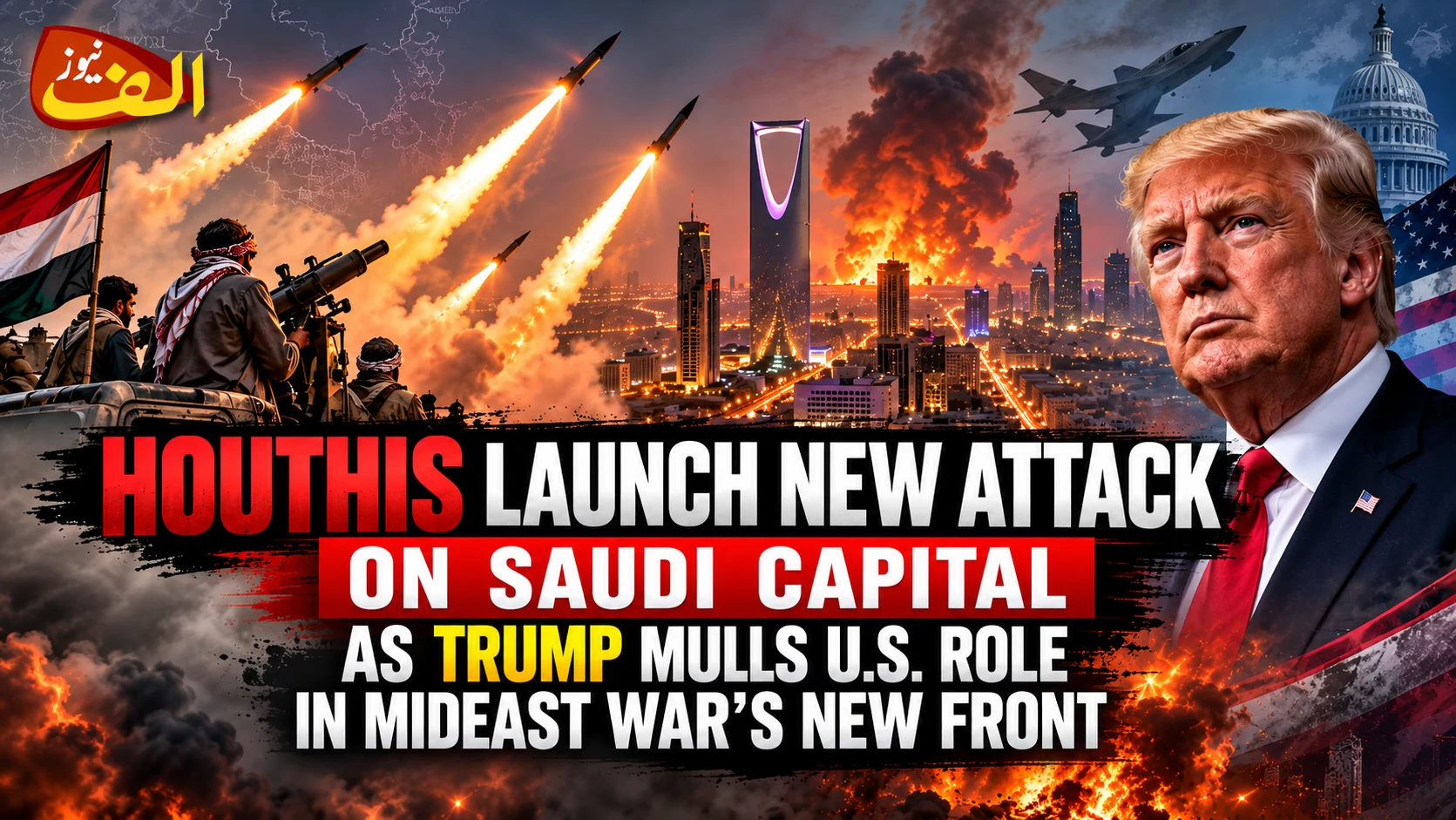
The Middle East is facing another dangerous escalation as Yemen’s Iran-backed Houthi rebels intensify missile and drone attacks against Saudi Arabia, raising fears of a wider regional conflict. The latest attack targeting Riyadh, the Saudi capital, comes as U.S. President Donald Trump considers whether American forces should become directly involved in military operations against the Houthis.
The rapidly deteriorating security situation has increased tensions between Saudi Arabia and the Houthi movement, disrupted international aviation, and raised concerns about global energy supplies.
As fighting continues across the region, the possibility of direct U.S. military intervention has become one of the most significant developments in the expanding Middle East conflict.
Fresh Houthi Missile Attack Targets Riyadh
On Wednesday, October 14, explosions were heard across Riyadh as Saudi Arabia faced another reported missile attack from Houthi-controlled territory in Yemen.
According to Saudi military officials, air defense systems successfully intercepted a ballistic missile launched toward the capital. Authorities had issued warnings about a possible aerial threat before the alert was lifted.
The latest incident followed a series of attacks targeting Saudi airports, energy facilities, and other critical infrastructure.
The Houthis have claimed responsibility for launching ballistic missiles, cruise missiles, and drones against several Saudi targets, including Riyadh’s international airport and Saudi Aramco facilities.
The escalating attacks have raised serious questions about the effectiveness of regional air defense systems and Saudi Arabia’s ability to protect major economic and civilian infrastructure.
Deadly Attacks on Riyadh International Airport
One of the most serious incidents occurred on October 10, when a missile struck King Khalid International Airport in Riyadh.
According to subsequent reports, the attack killed 13 people and injured hundreds, marking one of the deadliest attacks on Saudi territory in recent years.
The airport has been targeted repeatedly during the latest escalation, creating major disruptions for international travelers and airlines operating in the region.
Saudi authorities suspended airport operations, with the closure scheduled to remain in place until October 17.
The attacks have highlighted the vulnerability of essential transportation infrastructure and increased concerns about civilian safety.
Riyadh is an important international business and investment destination, and prolonged disruption to its airport could affect tourism, commercial activity, and foreign investment.
Trump Considers U.S. Military Intervention
The intensifying attacks have placed President Donald Trump under growing pressure to determine Washington’s next steps.
Trump has indicated that the United States is considering joining Saudi military operations against Houthi positions in Yemen. However, as of October 14, no final decision authorizing a new direct American military campaign had been announced.
The decision presents a difficult challenge for the White House.
Saudi Arabia remains an important American strategic partner, particularly in energy cooperation, regional security, and defense relations.
Supporting the kingdom militarily could demonstrate Washington’s commitment to its regional allies and potentially weaken Houthi missile and drone capabilities.
However, direct intervention could also expose American military personnel and facilities to retaliatory attacks, increase regional instability, and deepen U.S. involvement in the wider Middle East war.
The Trump administration must therefore weigh the potential military benefits against the political, economic, and security consequences of expanding the conflict.
Houthis Warn of Retaliation Against American Forces
The Houthi leadership has warned that any direct U.S. military involvement in attacks on Yemen could trigger retaliation against American interests across the Middle East.
Such warnings have heightened concerns about attacks targeting U.S. military facilities, personnel, and strategic assets stationed in the region.
The Houthis have developed increasingly sophisticated drone and missile capabilities during years of conflict in Yemen.
Their ability to target infrastructure beyond Yemen’s borders has made them a significant regional security challenge.
Although American military strikes might damage Houthi weapons facilities and launch sites, security analysts caution that airstrikes alone may not permanently eliminate the group’s operational capabilities.
Saudi Aramco Facilities Become Major Targets
The latest escalation has also threatened Saudi Arabia’s energy sector.
On October 13, an attack struck a Saudi Aramco facility in Dhahran, causing a fire and damaging parts of the complex.
The Houthis claimed attacks against additional energy-related targets and warned that oil infrastructure would remain vulnerable unless Saudi military operations in Yemen stopped.
Saudi Arabia plays a central role in global energy production and exports. Any sustained damage to its oil facilities could create uncertainty in international markets.
Even when production continues, the threat of repeated missile and drone strikes can affect investor confidence, transportation costs, and expectations about future energy supplies.
These developments are particularly concerning as the wider regional conflict has already disrupted major shipping and oil transportation routes.
Why Are the Houthis Attacking Saudi Arabia?
The latest confrontation is connected to Yemen’s long-running civil war.
The Houthi movement, formally known as Ansar Allah, controls significant areas of northern Yemen, including the capital, Sanaa.
Saudi Arabia intervened in Yemen’s conflict in 2015 to support the internationally recognized Yemeni government after the Houthis seized control of Sanaa.
Despite years of military operations and international diplomatic efforts, the conflict has remained unresolved.
A United Nations-brokered truce in 2022 reduced large-scale fighting for a period, but renewed clashes in 2026 have undermined that fragile stability.
The Houthis say their recent attacks against Saudi Arabia are retaliation for Saudi-backed military operations in Yemen.
Saudi Arabia, meanwhile, maintains that its actions are intended to support Yemen’s recognized government and counter threats posed by Houthi forces.
Iran’s relationship with the Houthis has further complicated the conflict, connecting Yemen’s internal war to wider regional competition.
Growing Threat to Global Oil Prices and Shipping Routes
One of the most significant consequences of the current crisis is the growing risk to global energy markets.
Two strategic waterways are particularly important:
The Strait of Hormuz: This vital passage connects the Persian Gulf with international shipping routes and is central to global oil and gas transportation.
The Bab el-Mandeb Strait: Located between Yemen and the Horn of Africa, this waterway connects the Red Sea with the Gulf of Aden and serves as a major route for international shipping.
The Houthis’ presence along Yemen’s Red Sea coastline gives them the ability to threaten commercial maritime traffic near Bab el-Mandeb.
At the same time, tensions involving Iran and the United States have disrupted shipping through the Strait of Hormuz.
If both routes remain under pressure, international trade could face higher insurance costs, expensive alternative shipping arrangements, and additional energy price volatility.
Countries dependent on imported fuel could be particularly vulnerable to prolonged disruption.
Humanitarian Crisis Deepens in Yemen
While military and diplomatic attention focuses on Saudi Arabia and the United States, the humanitarian situation inside Yemen continues to deteriorate.
Years of conflict have devastated infrastructure, displaced communities, and weakened essential public services.
Renewed military operations have increased the pressure on hospitals and humanitarian organizations working in affected areas.
The World Food Programme has warned that restrictions around Taiz have prevented humanitarian assistance from reaching more than 600,000 people who depend on aid.
Continued fighting threatens to worsen food insecurity and place additional civilians at risk.
International humanitarian organizations have emphasized the urgent need to protect civilians, maintain access to essential supplies, and prevent further displacement.
What Could Happen Next in the Middle East?
The coming days could prove decisive for the direction of the conflict.
If the Houthis continue targeting Saudi airports and energy facilities, Riyadh may intensify military operations against the group in Yemen.
The United States could also expand its security support for Saudi Arabia through intelligence cooperation, missile defense assistance, or additional military measures.
However, direct American strikes would carry the risk of Houthi retaliation and further escalation.
Diplomatic negotiations remain another possible pathway, although deep mistrust between the parties makes an immediate settlement difficult.
The response of regional governments, including Iran and Saudi Arabia, will play a major role in determining whether the crisis expands or moves toward de-escalation.
Conclusion
The latest Houthi attack targeting Riyadh represents another dangerous development in the expanding Middle East war.
Repeated strikes against civilian infrastructure, airports, and energy facilities have increased pressure on Saudi Arabia and placed President Donald Trump in a difficult strategic position.
Washington must decide how to support a key regional partner without becoming involved in another prolonged military campaign.
Meanwhile, the humanitarian consequences in Yemen and the potential disruption to global trade demonstrate that the crisis extends far beyond the battlefield.
As tensions continue to rise, diplomatic efforts to reduce hostilities, protect civilians, and prevent further regional escalation are becoming increasingly important.
The decisions made by Saudi Arabia, the United States, and the Houthis in the coming days could have lasting consequences for Middle Eastern stability and the global economy.