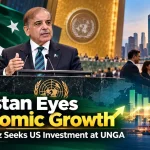


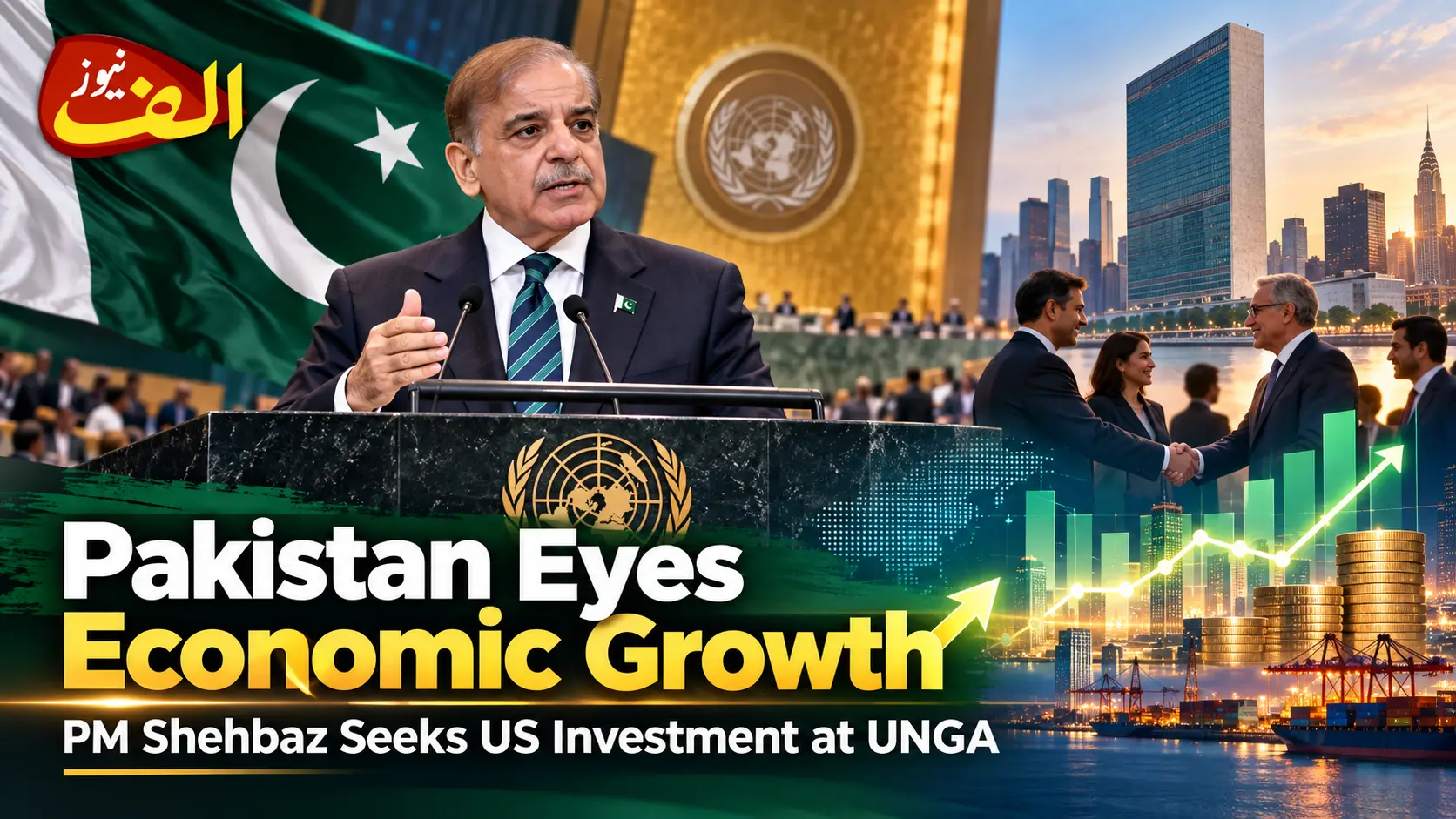
Pakistan is seeking to move from a period of economic stabilisation toward stronger investment and sustainable growth, with Prime Minister Shehbaz Sharif telling a delegation of Pakistani-American and US business leaders that the country is opening new opportunities for private-sector participation.
Pakistan economic growth 2026
During a meeting in New York on September 25, 2026, on the sidelines of the 81st session of the United Nations General Assembly, the prime minister met delegations from the US-Pakistan Business Council and the Business Council for International Understanding. He said Pakistan’s economy had stabilised and was now moving toward growth, while inviting investors to explore opportunities in agriculture, mining, information technology, artificial intelligence, energy and other sectors.
The message comes at an important stage for Pakistan. Official data show that economic activity improved during FY2025-26, but inflation and external risks continue to make the transition from stabilisation to sustained growth challenging.
Pakistan Moving From Stabilisation to Growth
According to Prime Minister Shehbaz Sharif, Pakistan has implemented major structural reforms aimed at improving economic management and creating a more efficient environment for businesses.
He highlighted the digitisation of the economy, reforms in the Federal Board of Revenue and expansion of e-governance as important parts of the government’s economic programme.
The latest Pakistan Economic Survey provides some support for the broader recovery narrative. Pakistan recorded 3.70% real GDP growth in FY2025-26, while agriculture expanded by 2.89%, industry by 3.51% and the services sector by 4.09%. The size of the economy at current market prices reached approximately Rs126.9 trillion.
These figures indicate that economic activity strengthened compared with the severe macroeconomic pressures Pakistan faced in previous years.
However, stabilisation does not automatically mean that all economic difficulties have disappeared. Inflation, employment, investment, exports, government revenues and the cost of doing business remain important issues for households and companies.
Agriculture Identified as a Major Investment Opportunity
Agriculture was one of the main sectors highlighted during the prime minister’s meeting with business leaders.
Pakistan has a large agricultural base, but productivity can be affected by outdated farming techniques, inefficient irrigation, post-harvest losses and limited access to modern machinery.
PM Shehbaz told the delegation that Pakistan could benefit from advanced agricultural equipment and technology, including modern harvesting machinery, to increase production while reducing costs.
Foreign and local investment could potentially support areas such as:
- Modern farm machinery and precision agriculture
- Improved seed technology
- Food processing and value-added agriculture
- Cold-storage infrastructure
- Agricultural exports
- Water-efficient irrigation systems
- Livestock and dairy development
Improving productivity would be particularly important because agriculture remains closely connected with employment, rural incomes, food security and Pakistan’s export sector.
Mining and Mineral Resources in Focus
Mining was another sector presented to investors as having considerable potential.
Pakistan has mineral resources that the government hopes can attract both domestic and international investment. Developing these resources, however, requires more than identifying mineral deposits.
Large-scale mining projects typically depend on infrastructure, regulatory certainty, transport networks, energy availability, environmental safeguards and long-term investment agreements.
The government is therefore seeking private-sector participation to help convert mineral resources into commercially productive projects. PM Shehbaz described the country’s mining potential as significant during his New York meeting.
If developed sustainably, mining investment could contribute to exports, employment, foreign exchange earnings and industrial development.
IT and Artificial Intelligence Could Drive Future Growth
Pakistan’s technology sector was also a major part of the government’s investment pitch.
The prime minister pointed to Pakistan’s large young population and said that information technology and artificial intelligence-based initiatives could create substantial opportunities.
He also stressed the importance of vocational and skills training to prepare young people for productive employment.
The technology sector has become increasingly important to Pakistan’s external economy. According to the Pakistan Economic Survey 2025-26, services trade benefited from stronger technology exports, with IT exports rising by about 19.8% during the period covered by the survey.
Continued expansion could potentially come from software exports, cloud services, cybersecurity, artificial intelligence, fintech, business-process outsourcing, e-commerce and remote professional services.
For Pakistan, technology exports are particularly attractive because they can generate foreign exchange without requiring the same level of imported raw materials as many traditional industries.
Privatisation and a Larger Role for Private Businesses
Privatisation was another important subject raised during the business meeting.
PM Shehbaz said the government’s role should increasingly be to facilitate private businesses rather than directly operate commercial enterprises.
He referred to privatisation initiatives involving state-owned enterprises and power distribution companies and said additional areas were being opened to private-sector participation.
The broader objective is to reduce losses associated with inefficient state-owned enterprises while encouraging private investment and improving service delivery.
The results, however, will depend on how individual transactions are structured, how competition is maintained and whether investors are provided with a transparent and predictable regulatory environment.
Foreign Exchange Reserves Have Strengthened
One of the most visible improvements in Pakistan’s macroeconomic position has been the rebuilding of foreign exchange reserves.
State Bank of Pakistan data showed that, as of September 11, 2026, SBP’s foreign exchange reserves stood at approximately $21.39 billion, while commercial banks held about $5.40 billion, taking total liquid foreign exchange reserves to approximately $26.79 billion.
Higher reserves can provide the economy with a stronger buffer against external shocks and help improve confidence in Pakistan’s ability to manage international payments.
Earlier in FY2025-26, workers’ remittances also remained an important source of external-sector support. The Pakistan Economic Survey reported remittances of approximately $30.3 billion during July-March FY2025-26, an increase of 8.2% from the corresponding period.
Inflation Remains an Important Challenge
Despite improvements in several macroeconomic indicators, inflation remains a significant concern.
Pakistan Bureau of Statistics data showed that national Consumer Price Index inflation reached approximately 11.1% year-on-year in August 2026, compared with 9.2% in July. Rural inflation was higher at around 12.2%, while urban inflation was approximately 10.4%.
This is important because economic stabilisation at the national level does not immediately translate into improved purchasing power for households.
Higher prices for food, energy, transport and other essentials can continue to put pressure on living standards even while GDP, reserves and other indicators improve.
The State Bank’s policy rate was 11.50% in September 2026, illustrating that monetary conditions also remain relatively tight as policymakers attempt to control inflation while supporting economic activity.
IMF Also Sees Progress but Warns of Risks
The International Monetary Fund has acknowledged improvements in Pakistan’s macroeconomic stability while continuing to emphasise structural reforms and fiscal discipline.
After completing its third review of Pakistan’s Extended Fund Facility in May 2026, the IMF said policy implementation had helped maintain economic stability and improve financing and external conditions despite regional shocks.
At the time, IMF staff expected growth to remain around the 3.5% to 4% range, while warning that higher fuel prices and weaker external demand could affect economic performance. The IMF also said sustainable medium-term growth would depend on structural reforms, improved competitiveness, stronger investment and exports.
This highlights the difference between economic stabilisation and long-term transformation.
Stabilisation can create the conditions required for investment, but sustainable growth requires improvements in productivity, exports, education, energy, taxation, governance and the overall business environment.
Why US Investment Matters for Pakistan
Pakistan’s meetings with American business organisations have a broader economic objective.
Foreign investment can bring not only capital but also technology, management expertise, access to international markets and integration into global supply chains.
Potential areas for Pakistan-US economic cooperation include technology, agriculture, minerals, energy, manufacturing, infrastructure and financial services.
For foreign companies, however, investment decisions are generally influenced by factors such as regulatory consistency, taxation, currency stability, contract enforcement, energy costs and the ability to repatriate profits.
Pakistan will therefore need to ensure that improvements in headline economic indicators are accompanied by improvements in the practical operating environment for businesses.
Regional Stability Remains Critical
The prime minister also linked economic development with regional peace.
Speaking to the delegation, he said regional tensions had affected Pakistan at an unfavourable time and stressed that peace was important for investment and business activity.
Geopolitical conflicts can raise global oil and commodity prices, disrupt shipping routes and weaken external demand.
Pakistan is particularly exposed to changes in global energy prices because of its dependence on imported fuel.
This means international developments can influence domestic inflation, the trade balance, foreign exchange requirements and production costs.
What Comes Next for Pakistan’s Economy?
Pakistan has clearly moved away from some of the immediate balance-of-payments pressures that dominated earlier periods, while GDP growth and foreign exchange reserves have improved.
The next challenge is converting that stability into growth that businesses and households can experience more directly.
That would require sustained private investment, stronger exports, productive employment, lower inflation, affordable energy, higher agricultural and industrial productivity and consistent economic policies.
The government’s focus on agriculture, minerals, IT, artificial intelligence and private-sector investment provides several potential avenues for expansion.
At the same time, August’s double-digit inflation shows why economic recovery should be judged through a broad range of indicators rather than a single measure.
Conclusion
Prime Minister Shehbaz Sharif’s meeting with US and Pakistani-American business leaders at the UN General Assembly reflects Pakistan’s effort to present itself as an economy transitioning from stabilisation toward investment-led growth.
Official figures show meaningful improvements in GDP growth and foreign exchange reserves, while reforms, privatisation and greater private-sector participation remain central to the government’s strategy.
However, elevated inflation, global geopolitical risks and the continuing need for structural reforms show that the transition is still underway.
Pakistan’s longer-term economic performance will therefore depend on whether macroeconomic stability can be maintained while attracting investment, increasing exports, creating productive jobs and improving the business environment.
The coming period will be important in determining whether recent stabilisation develops into durable and inclusive economic growth.