


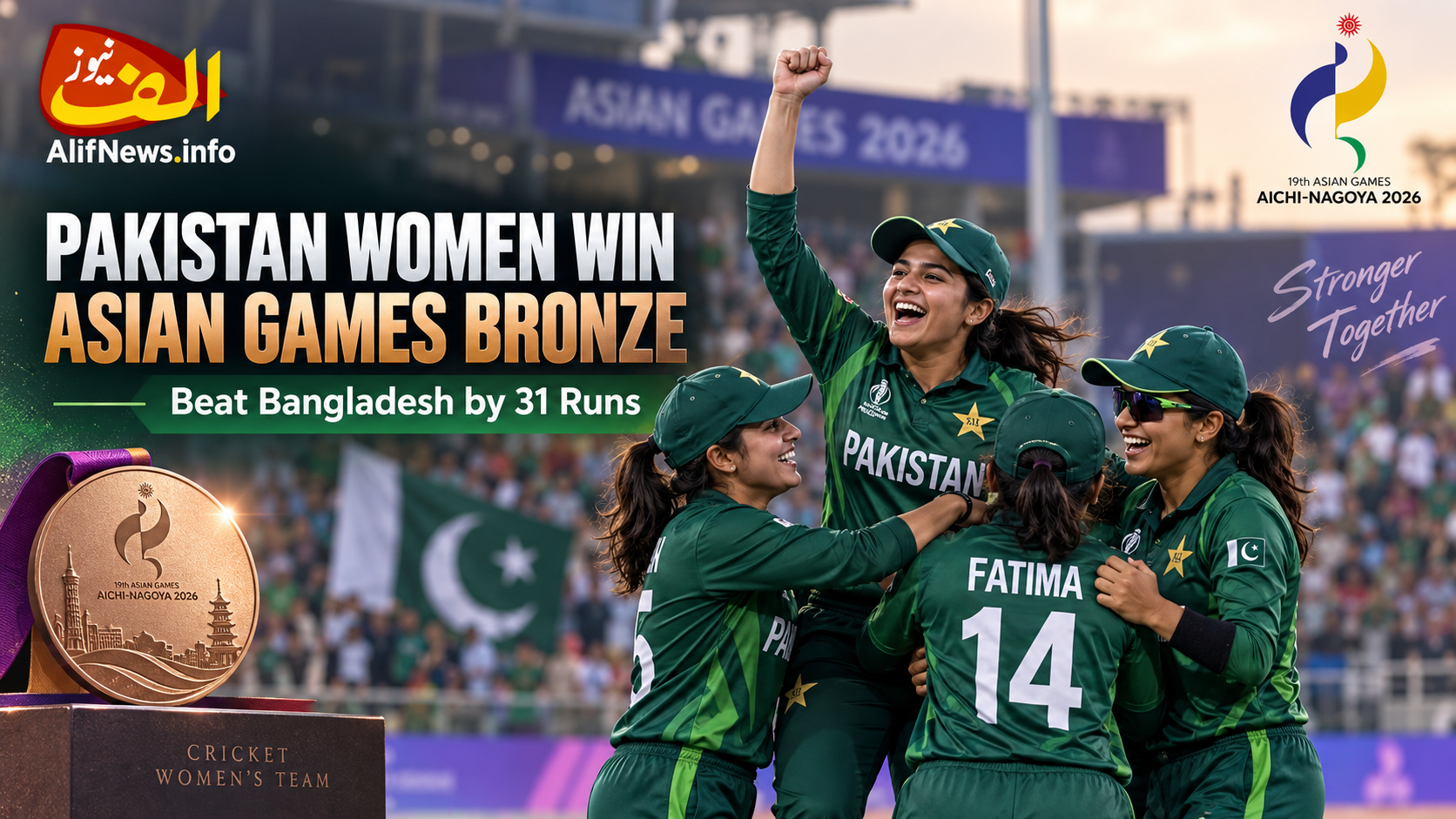
Pakistan women Asian Games 2026 bronze, Pakistan’s women’s cricket team has given supporters something to celebrate at the Asian Games 2026, defeating Bangladesh by 31 runs to secure the bronze medal in Japan.
It was not a straightforward victory.
Pakistan went from a comfortable opening partnership to a worrying middle-order collapse before captain Fatima Sana changed the direction of the match. Later, Umm-e-Hani produced the best T20I bowling figures of her career to shut down Bangladesh’s chase.
Pakistan finished with 145 for eight, before restricting Bangladesh to 114 for seven at Korogi Sports Park in Nisshin.
For Pakistan women’s cricket, the result carries more meaning than simply finishing third.
It is the country’s third medal in women’s cricket at the Asian Games and comes four years after Bangladesh defeated Pakistan in the bronze-medal match at the previous Games.
Pakistan Started Well — Then Everything Changed
The innings began positively.
Gull Feroza and Shawaal Zulfiqar put together a 46-run opening partnership, giving Pakistan a useful platform. Gull Feroza made 31 from 23 balls, while Shawaal contributed 17.
But cricket can change quickly.
Bangladesh found a way back into the contest and Pakistan suddenly slipped from 46 without loss to 67 for five.
At that stage, a competitive total no longer looked guaranteed.
Pakistan needed someone to absorb the pressure while still finding a way to score quickly enough in the final overs.
That responsibility fell to captain Fatima Sana.
Fatima Sana Changes the Match
Coming in at number seven, Fatima Sana played the innings Pakistan needed.
Rather than simply trying to survive the collapse, she began rebuilding with Aliya Riaz and gradually shifted the pressure back onto Bangladesh.
Fatima scored 45 from only 30 deliveries, hitting three fours and three sixes. Aliya Riaz supported her with 25 from 22 balls. Together they added a crucial 67 runs from 43 balls.
That partnership transformed the innings.
Pakistan had been 90 for five after 15 overs but accelerated strongly during the closing stages, eventually reaching 145 for eight.
It was not an enormous T20 total, but it gave Pakistan’s bowlers something meaningful to defend.
More importantly, the recovery showed why Fatima Sana’s role has become so important to this team.
A captain is often judged during uncomfortable moments, and Pakistan’s innings was certainly uncomfortable when the fifth wicket fell.
Fatima responded with runs rather than panic.
Umm-e-Hani Strikes Early
If Fatima Sana rescued Pakistan with the bat, Umm-e-Hani made sure Bangladesh never became comfortable in the chase.
Pakistan’s bowlers attacked early.
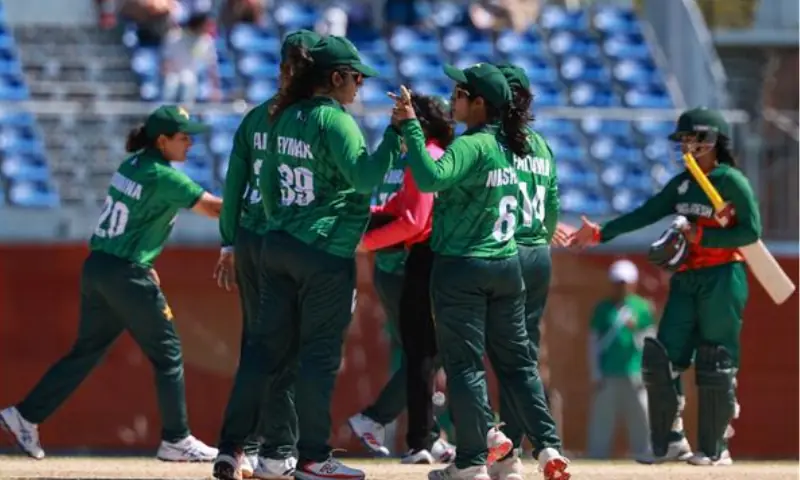
Bangladesh were reduced to 20 for three inside 4.3 overs, immediately pushing the required run rate upward.
Umm-e-Hani removed two early batters before returning later for another wicket.
She finished with exceptional figures of:
4 overs, 10 runs, 3 wickets.
The performance represented her best bowling figures in women’s T20 internationals, improving on her previous best of 2-28 against Sri Lanka.
In a medal match, conceding only 10 runs from four overs is the kind of spell that can quietly decide the entire contest.
There were no unnecessary extras, no expensive recovery over and very little opportunity for Bangladesh to regain momentum.
Bangladesh Tried to Fight Back
Bangladesh did not completely disappear after losing three early wickets.
Sharmin Akhter and captain Nigar Sultana attempted to rebuild the innings.
Sharmin remained unbeaten on 46 from 45 balls, while Nigar made 25. Their partnership temporarily gave Bangladesh hope of taking the chase deeper.
The problem was the required run rate.
With early wickets falling and Pakistan’s bowlers keeping the scoring under control, Bangladesh needed more than simply a steady partnership.
They needed acceleration.
That acceleration never really arrived.
Pakistan continued taking wickets at important moments, and Bangladesh eventually closed on 114 for seven — 31 runs short of the target.
A Medal With Some History Behind It
The bronze medal adds another chapter to Pakistan’s history in Asian Games women’s cricket.
Pakistan previously won gold medals in 2010 and 2014.
At the 2022 Asian Games in Hangzhou, however, Bangladesh defeated Pakistan in the bronze-medal playoff.
That gave this year’s third-place match an additional storyline.
Four years later, Pakistan faced Bangladesh again with another bronze medal on the line — and this time Pakistan finished on the winning side.
The result gives Pakistan three Asian Games medals in women’s cricket overall.
Pakistan’s Route to the Bronze Medal
Pakistan’s Asian Games campaign had its difficult moments.
The team defeated Thailand by three wickets in the quarter-final on September 17.
That victory earned Pakistan a semi-final against Sri Lanka.
Pakistan produced a strong batting performance in that match, scoring 177 for four, but Sri Lanka chased the target successfully and won by eight wickets, ending Pakistan’s hopes of reaching the gold-medal match.
That defeat could easily have affected the team mentally.
A bronze-medal match arrives quickly after the disappointment of losing a semi-final. Players have very little time to process the missed opportunity before being asked to compete for another medal.
Pakistan responded well.
Instead of allowing the semi-final defeat to define the tournament, they recovered against Bangladesh and left Japan with a place on the podium.
Fatima Sana’s Growing Importance
One of the strongest stories from this result is the continued development of Fatima Sana.
She did more than top-score with 45.
She also contributed with the ball, taking one wicket, giving Pakistan another all-round performance from its captain. PCB reported that she has been Pakistan’s leading run-scorer in women’s T20Is in 2026 and had reached 540 runs for the year following this innings.
Those numbers matter, but her role goes beyond statistics.
Pakistan needed its captain when the batting order was under pressure.
She responded.
Pakistan needed control while defending the total.
She contributed there too.
For a relatively young side trying to establish consistency at international level, performances like this can become important building blocks.
Umm-e-Hani Gives Pakistan Another Positive Sign
The other major takeaway is Umm-e-Hani.
Her 3-10 did not simply help win one match. It showed that Pakistan has another bowler capable of producing a match-defining spell under pressure.
Bowling in T20 cricket is increasingly difficult. Batters attack early, boundaries are heavily valued and one expensive over can alter an entire match.
Against Bangladesh, Umm-e-Hani gave away just 10 runs across 24 deliveries.
She also delivered a wicket-maiden.
That combination of wicket-taking ability and economy was central to Pakistan defending 145.
More Than Just a Bronze Medal
Pakistan would obviously have preferred to compete for gold.
The semi-final defeat against Sri Lanka means there are still areas the team will want to improve.
But tournaments are not only measured by the match that was lost.
They are also measured by how a team responds afterwards.
Pakistan entered the bronze-medal contest after missing the final, suffered a major batting collapse, rebuilt the innings, took early wickets and then controlled Bangladesh’s chase.
That resilience is arguably the most encouraging part of the result.
Final Score: Pakistan vs Bangladesh
Pakistan Women: 145/8 in 20 overs
Fatima Sana 45, Gull Feroza 31, Aliya Riaz 25
Bangladesh Women: 114/7 in 20 overs
Sharmin Akhter 46*, Nigar Sultana 25
Pakistan won by 31 runs
Best Pakistan bowling: Umm-e-Hani 3-10
The official PCB report confirms Pakistan’s 31-run victory and bronze medal.
What This Means for Pakistan Women’s Cricket
The Pakistan women Asian Games 2026 bronze may not carry the same headline value as a gold medal, but it remains a meaningful result.
Pakistan leaves the tournament with a medal, a captain delivering under pressure and emerging players producing important performances on an international stage.
For supporters, perhaps the best part of the victory was the way it happened.
Pakistan were not dominant from the first ball.
They were tested.
They lost momentum.
Then they found a way back.
Fatima Sana rebuilt the innings. Umm-e-Hani attacked with the ball. The rest of the bowling unit protected the total.
The bronze medal was earned through recovery rather than comfort.
And for a developing team, learning how to win from difficult positions can sometimes be as valuable as the medal itself.