

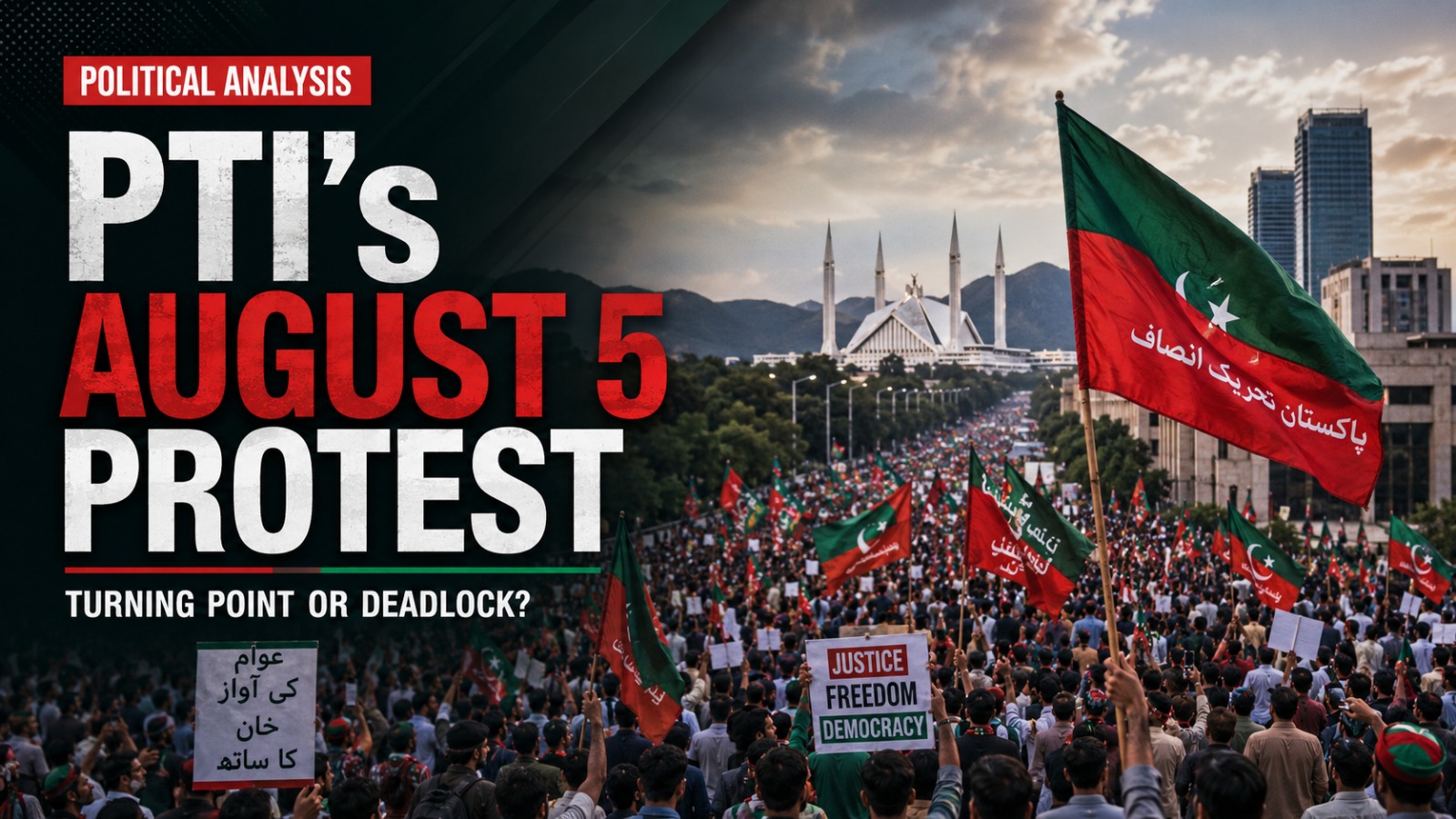
Pakistan Tehreek-e-Insaf is preparing to begin a nationwide protest movement on August 5, 2026. The campaign may test PTI’s organisational strength, the government’s political strategy and the possibility of meaningful dialogue between the country’s major political forces.
## A New Phase in Pakistan’s Political Conflict
Pakistan’s political environment is heading towards another important test as Pakistan Tehreek-e-Insaf prepares to launch a nationwide movement on August 5, 2026.
PTI’s parliamentary party announced that the campaign would demand the release of former prime minister Imran Khan and the acceptance of the party’s other political demands. The date marks three years since Khan’s arrest in August 2023.
The opposition alliance Tehreek Tahaffuz-e-Ayin Pakistan has also announced rallies and a public outreach campaign beginning on August 5. The alliance has linked its movement to what it describes as Pakistan’s worsening political, constitutional and security situation.
The protest is therefore not being presented as a single-day political gathering. PTI leaders are attempting to portray it as the beginning of a broader campaign against the government.
The major question is whether the movement can produce sustained political pressure or whether it will become another temporary show of strength without delivering a political breakthrough.
What Does PTI Want?
The release of Imran Khan remains PTI’s most prominent demand. However, the party’s political message now includes wider complaints about governance, the economy, alleged political victimisation and the credibility of Pakistan’s political system.
PTI Secretary General Salman Akram Raja has accused the government of corruption, economic mismanagement and political victimisation while asking the public to participate in the August 5 demonstrations.
Senior PTI leader Asad Qaiser has also argued that fresh general elections are the only solution to Pakistan’s political and economic problems.
This indicates that PTI’s campaign is not limited to securing legal relief for its founder. The party is trying to connect Imran Khan’s imprisonment with broader public concerns about political representation, economic pressure and government legitimacy.
Whether that strategy succeeds will depend on PTI’s ability to attract people beyond its committed supporters.
## PTI’s Organisational Challenge
PTI continues to possess a large political support base, particularly among young voters, urban communities and sections of the Pakistani diaspora.
However, public popularity and effective street mobilisation are not always the same thing.
A successful nationwide movement requires strong coordination between the party’s central leadership, provincial organisations, elected representatives, local workers and opposition allies.
PTI must also present a clear strategy. The public needs to know whether the campaign will consist of peaceful rallies, extended demonstrations, legal action, parliamentary protests or negotiations with the government.
Without a clearly defined objective, political movements can lose momentum even when they begin with significant public attention.
The August 5 campaign will therefore test whether PTI’s current leadership can convert support for Imran Khan into a disciplined, peaceful and sustainable political movement.
## The Battle Over Permission to Protest
The right to peaceful protest has already become part of the political dispute.
PTI leaders in Lahore said they would approach the courts after the district administration did not respond to their request for permission to hold a peaceful gathering on August 5.
This issue creates a difficult situation for the government.
Authorities have a responsibility to protect public safety, prevent violence and ensure that roads, businesses and emergency services continue to operate. At the same time, political parties have a constitutional right to organise peaceful public gatherings within the limits of the law.
Excessive restrictions could strengthen PTI’s claim that it is being denied political space. On the other hand, any violence or serious disruption during the demonstrations could damage PTI’s democratic message.
Both sides will therefore be judged by their conduct.
The government must avoid treating peaceful political activity as a security threat, while PTI must ensure that its supporters remain within constitutional and legal boundaries.
Can the Movement Force Imran Khan’s Release?
Street protests can increase political pressure, but they cannot directly replace judicial procedures.
Imran Khan’s legal situation involves multiple cases and court proceedings. PTI may use public mobilisation to demand fair trials, improved access to legal representation and faster decisions, but the final legal outcomes must come through the courts.
On July 31, the Supreme Court accepted a chamber appeal filed by the PTI founder and ordered that the matter be fixed before a bench. The development shows that the legal process remains an important part of PTI’s wider political struggle.
The party must therefore balance two strategies: legal action inside the courts and political mobilisation outside them.
If PTI focuses entirely on street pressure, it may struggle to produce a practical legal outcome. If it depends only on court proceedings, it may fail to maintain political momentum among its supporters.
## Government Strategy: Resistance or Dialogue?
The government faces three broad choices.
It can attempt to contain the movement through administrative restrictions and law-enforcement measures. This approach may limit demonstrations temporarily, but it could also increase political anger and deepen the perception that opposition voices are being suppressed.
The government could also ignore the movement and hope that it loses momentum. This strategy may work if public participation remains limited, but it becomes risky if demonstrations expand across major cities.
The third option is political dialogue.
Dialogue does not require the government or PTI to accept every demand made by the other side. It requires both parties to identify issues that can be addressed through Parliament, courts, electoral reforms and constitutional procedures.
Reports have suggested that informal contacts between government and PTI figures have continued despite the public political confrontation, although no confirmed formal dialogue process has emerged.
A structured negotiation process could reduce tensions, but it would need clear participants, an agreed agenda and public accountability. Secret or informal meetings are unlikely to build public trust unless they lead to measurable progress.
## The Risk of Political Violence
Pakistan’s previous protest movements have often been affected by arrests, road closures, clashes and allegations of excessive force.
The August 5 campaign comes at a particularly sensitive time because the country is also facing serious security challenges.
A suicide attack on an anti-militancy rally in Swat on August 2 killed at least 14 people, including civilians and police officers. The rally had been organised by residents demanding peace and stronger action against militancy.
This security environment makes peaceful political conduct even more important.
The government must distinguish between peaceful protesters and individuals involved in violence. PTI, meanwhile, must prevent any attempt to use its demonstrations for confrontation, vandalism or attacks on public institutions.
Violence would shift public attention away from political demands and towards questions of law and order. It could also provide justification for wider restrictions on political activity.
What Would Make the Movement Successful?
PTI’s movement cannot be judged only by the size of its rallies.
A successful democratic campaign should achieve at least one of several objectives: opening a credible dialogue, accelerating lawful court proceedings, presenting a clear reform agenda, increasing peaceful public participation or encouraging Parliament to debate the country’s political crisis.
The movement would be less successful if it produced only confrontation, temporary disruption and another cycle of arrests.
PTI also needs to explain what happens after August 5.
A political campaign requires a realistic roadmap. The party should clarify its immediate demands, its negotiating conditions and the constitutional mechanism through which it wants those demands addressed.
Similarly, the government should explain how it intends to reduce political polarisation. Simply maintaining power without addressing public mistrust cannot provide long-term political stability.
## Possible Scenarios
### 1. Large but Peaceful Participation
If PTI attracts significant crowds without violence, it could strengthen the party’s negotiating position and place pressure on the government to consider dialogue.
### 2. Limited Public Response
If participation remains concentrated in PTI’s strongest areas, the government may describe the campaign as politically unsuccessful. This could also expose organisational weaknesses within the party.
### 3. Administrative Crackdown
Large-scale arrests or restrictions may reduce immediate participation but could increase sympathy for PTI and intensify political polarisation.
### 4. Government–Opposition Dialogue
The most constructive outcome would be the beginning of formal negotiations covering political prisoners, electoral disputes, parliamentary cooperation and constitutional rights.
### 5. Prolonged Political Stalemate
The most likely risk is that the protests continue without either side changing its position. Such a deadlock would increase uncertainty without solving the underlying political conflict.
Conclusion
PTI’s August 5 movement is an important political test, but it will not automatically transform Pakistan’s political landscape.
Its impact will depend on public participation, party discipline, the government’s response and whether both sides are willing to move from confrontation towards a constitutional political process.
For PTI, the challenge is to turn support for Imran Khan into a peaceful and organised democratic campaign with clear and realistic objectives.
For the government, the challenge is to maintain public order without closing legitimate political space.
Pakistan cannot permanently resolve its political disagreements through protests, arrests or administrative restrictions. Sustainable stability requires credible institutions, independent legal processes, parliamentary engagement and meaningful political dialogue.
August 5 may increase political pressure, but the real turning point will come only when Pakistan’s political leadership decides to replace confrontation with a workable constitutional settlement.